
alienated versus "intimate" writing
and what's coming this season

“Stop thinking of language as something that distinguishes us from or in the order of nature and start thinking of it as a craft by which we sense our connection to the earth.”
—Crispin Sartwell, End of Story: Toward an Annihilation of Language and History (2000)
“The goal of our conscious existence is quite simply to make meaning together. It is to continue a conscious expression of what the world means in the hope of touching, reaching, and joining with others to advance a mutual understanding; it is to participate together in writing the truth of our shared world. Through speaking and writing we make an effort to express what is beyond ourselves and to include others; it is through such expression that we create the relation that enables us to reach the truth we share.”
—Barbara Couture, Toward a Phenomenological Rhetoric: Writing, Profession, and Altruism (1998)
Hi, all, sorry you haven’t heard from me in a while 😬 I have been writing a ton in three dimensions and I’m excited to share it all with you this season!!
This month, I’ll be continuing our series on “Artificial Writing and Philosophies of Alienation.”
Alienation, an idea taken up by many philosophers in many contexts, means profound estrangement or disconnection—how does this relate to writing and AI writing products? Bringing in the work of Black existential philosophers, philosophy of labor, and eco-philosophy, I discuss AI writing and alienation of the self; alienation of the worker / labor (the next piece); alienation from environment, senses, and the body; and alienation from humanity and human capacity (including skills, contributions, and moral capacity).
Now, it’s really important that I not just present thoughts on the alienating power of AI, but that we go forward with an understanding of what we are trying to do instead.
So before we get into more philosophies of alienation concerning writing, I want to introduce the language I have begun to use to describe “non-alienated” or “non-artificial” writing: I am calling it “intimate writing.”
(Young Thug / Gunna)
Defining “intimate writing”
“Intimate writing” is a good expression of what we have been doing here and what my work with writers is about–being close to things, the details, the weirdness of up-close and all-around. Intimate writing knows that closeness to what is is the greatest opportunity to explore what is possible, like the way we can discover the whole meaning of a piece in a single word choice, the impact of which had initially withdrawn from the writer until he paid closer attention to his choice.
Intimate writing is non-alienated from its activity. Intimate writing understands the experience of writing as unalienable to its value and meaning. Intimate writing brings the writer closer to her body, resisting the disembodied mirroring of AI products. Intimate writing involves liberating, relaxing movement; it responds to important signals of desire felt in the body. The intimate writer feels resonance and music in her writing and reading through the body; in her writing body, she finds herself ‘among.’ The body-among-bodies is as meaningful a framework for intimate writing as the idea of an independent brain is absurd. We can use the words “embodied” as well as “related” to think about intimate writing.
Intimate writing is related to a reader and group of readers; it relates to inspiration and influences and compassion with other writers and artists. Intimacy between oneself and one’s writing is extended through relationships between the writer and the larger idea and life of writing (something with a past, present, and future), with the reader, with other writers and artists, with the ‘subject,’ and with larger projects of connectivity, such as having an ethical ecology of writing, or a concept of collaborative ethics.
Intimate writing cares what it is about and who it is for (as I wrote in the essay “From the heart,” this writing moves through and to, is from and for). It is not attached to concepts of movement or progress before considerations of what is needed–rather than producing to produce, building to build, scaling to scale, execution over idea, intimate writing cares about what it is about, and around.
By “intimate writing” I mean writing that is an experience of closing the alienation gap between laborer and production (as we will discuss in my next piece), between the self and other or subject / object; between all of these things; and writing that takes as its aim a greater intimacy with things that are. Intimate writing does not even hold that these things are separate and that there is a ‘between’ self and other. In this way intimate writing is both embodied and non-local—an “expression of the self” (Yagelski) and an experience of connectivity that extends far beyond the place and substance of the individual writer who is “being” or becoming in the experience of their writing. This is how we begin to talk about an ecology of writing, or the series of relationships that make up writing.
Of interest to us going forward in this Philosophy of Writing is: how does intimate writing work to bridge the gap between the writer and the ‘product of their labor’? How does it connect the writer to himself, engaged in the act of writing, as part of a much wider world of connectivity, among human beings, and including nonhumans and the environment?
AI is the apex product of capitalism, which requires alienation to function. It feeds off of alienation–don’t look at where this comes from, don’t look at what it costs. Like the fake personalities added to the AI product, or a woman’s body pasted onto a car that’s for sale, marketing relies on representing proximity to a recognizable ‘source of production’ to the consumer (as Susie Orbach described in Anorexia as a Metaphor for Our Age, the subject of future writing)—a body, a personality, which serves to soothe us into imagining that this product is closer to (intimate with) something human, something real.
Soothing feelings of alienation that threaten capitalism is the project of marketing, from commercials for skin products to cars to old-age homes. The personalities attached to these AI products makes consuming them feel like something productive, just as buying the car makes you seem like a productive, achievement-oriented person of means and qualities. I want to argue really clearly that the productivity experienced by using these products is equivalent to consumption. This is distressing and not surprising—how long has the promise of greater productivity been for sale, from automobiles to the App Store? Barely have we begun to ask such questions as: “for what?” Let alone, “At what cost?”
That is why the themes that come up in our discussions of alienating writing products (AI) in this series are familiar to readers of this newsletter and anyone who knows me. Capitalism defined how most of us first encountered writing. It was taught to us as individualistic, product-oriented, de-contextualized from place, and content-neutral. What mattered was ‘executing the algorithm,’ following the conventions to succeed and move up and get ahead. The writing we learned was conformist, process-prescriptive, and aligned to the status quo–the writing we were taught, and the way we were taught it, assumed that the status quo was worthy of being upheld, because otherwise how would we know how to help you succeed within it, get a job and make money?
Your writing today can explode all of this, by identifying and deconstructing the rules that control our behavior, how we learned them, and what beliefs about ourselves and the world they uphold. We then have our relationship with writing in which to articulate new beliefs that more closely (intimately) carry our real values and worldview. Rather than being a project of individual identification, positioning the project of ‘selfhood’ as a competition between you and others, our writing is our relating. Writing is connecting.
The way I always describe the basis of the basis of my work is something I figured out not within my own experience as a writer but from all of the writers I have worked with:
The relationship you have to writing is a lot like the relationship you have with yourself! If this is true, the risk of using a product of alienation to ‘augment’ your writing is profound.
Crucial to the philosophy we are engaging here is a liberating skepticism toward that “self”: Who is it? Intimate writing assumes that that self is not a single, individual, findable resource to be mined, but an ongoing relationship with everything that is. The world is real and other people are as real as you. A conception of intimate writing, I hope, can give us something to imagine in how to live through and toward these relationships, and how we value that writing relationship as connected to all these other aspects of your concern and joy in the world. As we will learn from the philosopher Erich Fromm, in “Alienation of Human Capacity,” joy is not separate, not alienated, but entirely concomitant to concern.
In “The Pathology of Normalcy” Fromm writes: “Joy, energy, happiness, all this depends on the degree to which we are related, to which we are concerned, and that is to say, to which we are in touch with the reality of our feelings, with the reality of other people, and not to experience them as abstractions that we can look at like the commodities at the market. Secondly, in this process of being related, we experience ourselves as entities, as I, who is related to the world.”
The Latin roots of “intimate” also carry the meanings “intrinsic” and “good friend.” What if writing could feel intrinsic (coming through us, of us) and like a good friend (an ‘other’ we relate to and through)? And what if this “good friend” wasn’t a product to consume but a way of being in the world?
I hope this idea is helpful as we continue to explore these philosophies of alienation as they relate to AI writing products, the relationship between productivity and consumption, what actual creativity and true, non-alienated productivity can feel like, and continue to imagine another way of being through work and art that does not rely on consuming products and divesting ourselves of what is human and already free and available.
Since we’re just getting back into this together, I wanted to round up the Alienation series so you know what it all is and what’s about to come to your inbox. And, now you have something to share with others if you think they would be interested in subscribing for the journey!
Artificial Writing and Philosophies of Alienation
Alienation of the Self
This piece, which has been published, explored the work of psychotherapist, philosopher, and victim of the State Frantz Fanon. We looked at how the language we use forms our self-conception and our worldview, and how using AI writing products might enforce language (and the ideas they carry) into the writer without their knowledge or consent. We explored how using these products further alienates the writer from the sense of themselves as the ‘writer writing,’ or the one ‘creating’; the sense of what writing is ‘theirs’ versus what the product supplied; and the sense of their own ability to ‘perform writing.’
Alienation of the Worker
We began in the first post to talk about a self-alienating language and a self-alienating labor–work that does not seem like mine. This post will get into how that gap between “myself” and “my work” is exploited (required) by capital, as well as the simultaneous diminishing of any gap whatsoever between productivity and consumption–AI, the apex product of capitalism, closes the wheel of the consumption machine, where even the act of work (or learning!) is the consumption of a product. Consumption on a massive, devastating environmental scale is also the means of production that the worker / consumer must deny that she is complicit in–a further alienation from moral capacity as well as freedom of choice.
This piece will focus largely on the philosophy of Karl Marx, who described the alienation of labor (or the worker) under capitalism in three ways: alienation of “the worker’s relationship to the products of his labor,” alienation from “the act of production,” and alienation from “nature and the life of the species.” I also include the philosopher Erich Fromm’s response to Marx’s work on alienation—defining what “non-alienated activity” might feel like.
Alienation of Human Capacity
Humans are incredible beings, who are sensitive, caring, can think, feel, and make meaning—yet we do not live our full capacity. The philosopher Ludwig Feuerbach believed that human beings ‘gave up’ their own moral capacity, skill and values, when they assigned them to God. The more one believes in a transcendent being or the possibility of ‘transcendence,’ they become alienated from what is truly possible through their own potential.
In this piece, I discuss Feuerbach’s work along with Fromm and Marx, to describe a “rich life” of humanity that is not alienated from its productivity or true potential. How does the way we treat AI products as ‘transcendent’ alienate us from our own capacity to express the gifts and potential of being human? How do we figure out exactly what those gifts and potential are? What does true productive fulfillment feel like?
Toward an Ecology of Writing
This piece grew too big to be part of the Alienation series, but will be a response to the initial feelings that compelled me to start writing about AI in the first place –the nauseating scale of environmental devastation.
This piece will ask: if AI separates us in all of these important ways from the means of production (what is required for the product to exist), how does writing respond? How does writing more actively engage our ethics and values, not just in the things we write about or how we see things, but in the production as well as the purpose?
We are going to take up this important political, ethical, and actionable question in this piece, where I’ll include the truly amazing work of:
writing pedagogist Robert Yagelski, who has written in Writing as A Way of Being: Writing Instruction, Nonduality, and the Crisis of Sustainability about writing instruction as complicit in the climate crisis and how writing can become a practice of community resiliency in the face of ecological devastation;
the ontological philosopher Timothy Morton, who in his books Hyperobjects: Philosophy and Ecology After the End of the World, and All Art is Ecological (I am reading this now), as well as many other works, writes about the responsibility of art in the anthropocene;
environmental philosopher and most beautiful science writer of all time Rachel Carson, who represents how urgently craft can respond to ongoing climate crises, and who through her art and activism invented the concept of ecology;
and environmental philosopher Rob Nixon, who wrote about the role of writers and artists in communicating, representing, and witnessing the impacts of the climate crisis in his book Slow Violence and the Environmentalism of the Poor.
There are many other pieces in my drafts folder for you guys, on other philosophers who can show us something interesting about writing and expand our understanding of intimate writing, as well as more fun craft and language and practice moments.
Thank you so much for reading and sticking around! If you know anyone who’d be interested in this series or the other things I write about, including writing craft, process, and practice, please share this newsletter! Or else, get out while you still can!
Hit me up rachel@racheljepsen.com
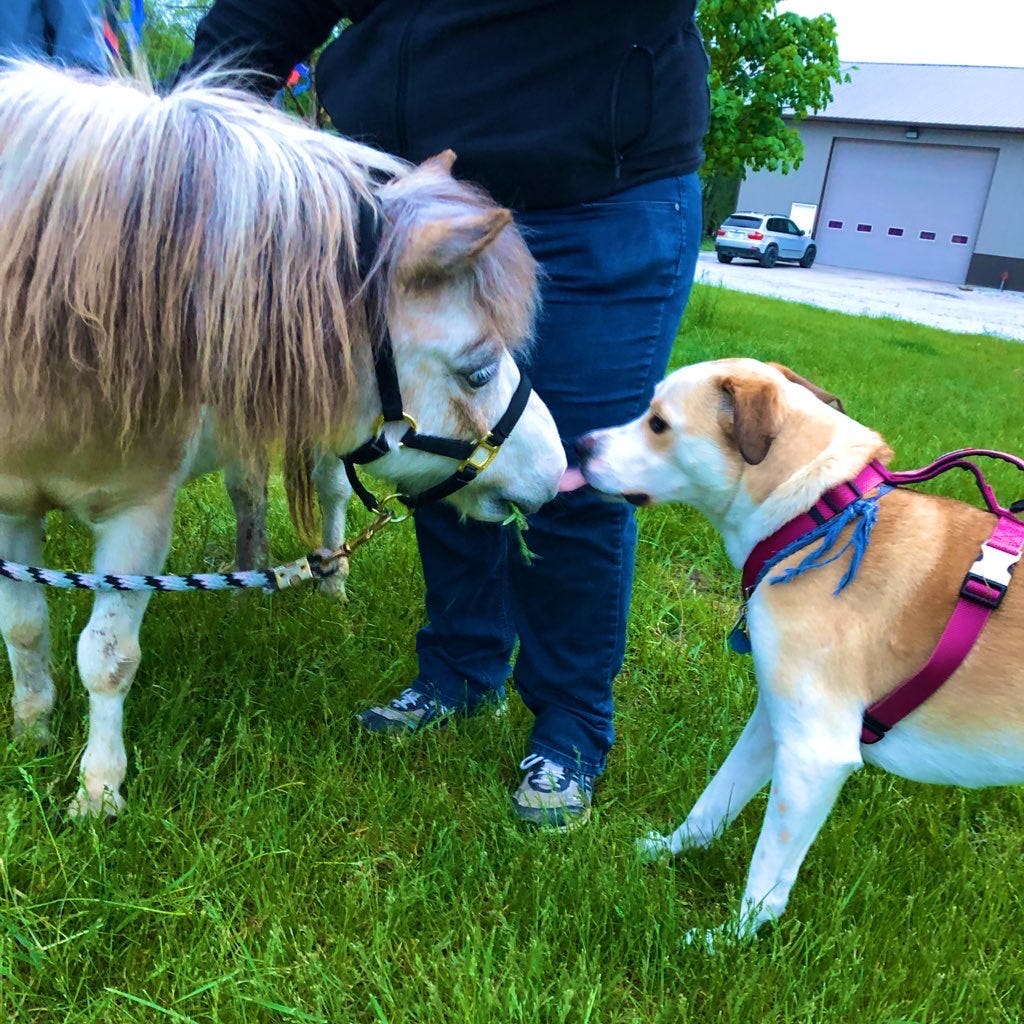
I will include cute pics of my dogs at the end of these long posts to reward those of you who made it here. This is the time Bird met a mini horse (her first ever horse!). I forget the horse’s name.
Great to see you emerge from your deep dive into three dimension for writing. While the noise is about artificial intelligence, you address the piece of that I care about, artificial writing. Plus philosophy and human thinking on questions bubbling up in the name of artificial writing.
the experience of writing is a part of the writing... livingessay.org