
the subtle writer

“Saturation—the world is
its own music in awe and
space and not flat these
dynamics of rising
horizon remember the narrow
loom’s scale, perspectival
innuendo’s subtle registration
of touch, we listen, eye
in the hand, mind
in the eye of the hand.”
—Norma Cole, “Stay Songs, for Stanley Whitney” (2001)
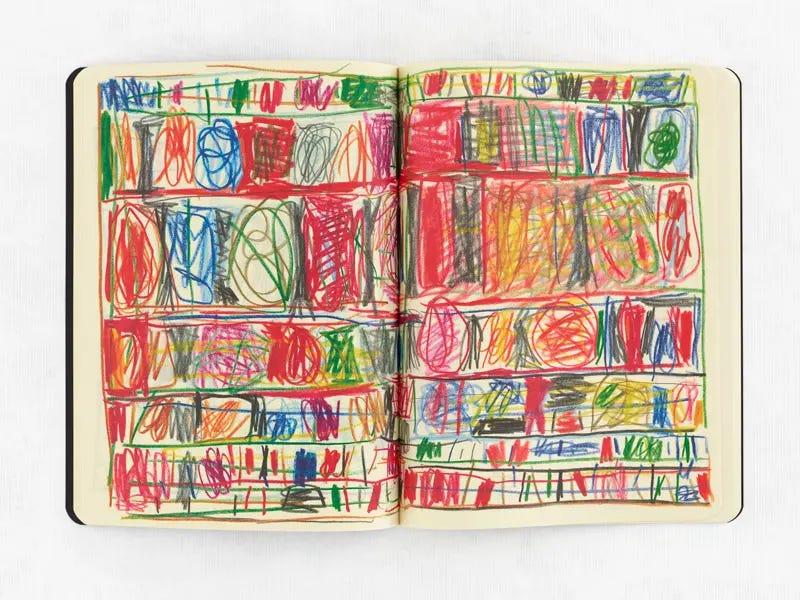
Stanley Whitney, Sketchbook1
What could it mean to be a subtle writer?
Imagine yourself floating on water.
Sense whether you would have preferred I write “in.”
How do you see yourself? Where is this water? What can you feel?
“If, for example, you simply lie on the water and float, then that is an active process, although it looks entirely passive, since a person who cannot swim, also cannot passively float because he does not have control over the delicate balance that is necessary to float.”2
How much can I be in water and still be floating?
How little can I touch the writing and still be writing?
The roots of subtlety: “This is from sub ‘under’ + -tilis, from tela ‘web, net, warp of a fabric,’ a derivative of texere ‘to weave, construct’ (see text (n.)). According to Watkins, the notion is of the ‘thread passing under the warp’ as the finest thread.”3
To know and keep writing as something beside you, to dip in and out of, to know you are always ‘of.’ To know writing / experience isn’t ‘finding the voice / story / truth / self,’ step-by-step, but is doors falling open, dropping like canyons through the ocean floor.
One writer says, “Writing is peanuts.” No big deal.
Another writer says, “Writing was so big in front of me I couldn’t see it or see beyond it. Now it sits beside me like a lamp. On or off, there it is. Part of the room.”
“For the sea as a whole, the alternation of day and night, the passage of the seasons, the procession of the years, are lost in its vastness, obliterated in its own changeless eternity. But the surface waters are different. The face of the sea is always changing. Crossed by colors, lights, and moving shadows, sparkling in the sun, mysterious in the twilight, its aspects and its moods vary hour by hour. The surface waters move with the tides, stir to the breath of the winds, and rise and fall to the endless, hurrying forms of the waves.”
The subtle writer pauses in the wind to hear five types of wind. (“And it is not ‘art.’”)4
It is in their body writing, knows the body is writing, thinking is sensed, writing is sensing. Writes experience as light through the prism of the body.
Turns on a light in the mind with a question, records what the light bounces off of.
(“A blue glass appears to be blue when light shines through it because it absorbs all other colors and thus does not let them pass. This is to say, we call a glass ‘blue’ precisely because it does not retain the blue waves. It is named not for what it possesses but for what it gives out.”5)
The subtle writer is engaged in gentle ‘ritual’ to create a timesome experience of writing–it creates time, and time is both unbounded and contained (space). Things feel nice.
The subtle writer might take notes, but not keep a journal. They might keep a journal, but it’s not an obligation. Writing works beside them.
Relaxes. Breathes the ‘subtle breath’ that weaves life, weaves through your life.
To let words fall like breath onto the page—can be voluntary or involuntary.
To not judge.
The subtle writer looks around in a field. Wonders, how is writing a field, a wave, a particle?
The subtle writer writes because it feels good and fulfilling and deepens their attention and experience of life, not because it proves something about them to have done. Though some things will become true about them by doing it.
Senses the difference between writing that is very uncomfortable and writing that shouldn’t hurt this much–deep stretch versus pulled muscle.
The subtle writer calmly relates to the output of writing–relates to it, learns, appreciates. Good or bad it is no more important than the process of creating was.
The subtle writer unclenches just one more percent, of one gripped tentacle arm, and that’s enough when you really feel it. Bit by bit is a lot.
The subtle writer uses their senses to feel into when writing wants to happen, and what wants to happen in writing.
Subtle knowing of: “what the writing wants,” meaning “what the writer wants.”
But it’s helpful to feel for the writing–we can be empathetic to writing when intimacy with ourselves / our desires feels very hard. This can be subtle: we feel for what writing wants, what would help writing, and this helps us experience our own desires, with and for it and beyond. An intimate relationship with writing closes the gap.
“So intimate is the union that the plant seems part of the rock.”6

From Megan N. Liberty for The Brooklyn Rail: “Juxtaposed with his ‘finished’ drawings, the sketchbook provides a glimpse into Whitney’s working methods that makes clear the relationship between formal design and text-based literary thinking, with text offering a background narrative to Whitney’s formal inventiveness.”
Erich Fromm, “Problems of Surplus” (1970)
Etymonline.com
George Oppen, Of Being Numerous, 1968
Erich Fromm, To Have Or to Be? (1976)
Rachel Carson, “The Rocky Shores,” from The Edge of the Sea (1955)