
No Meaningless Sequences
release the liquid chain of your wandering mind

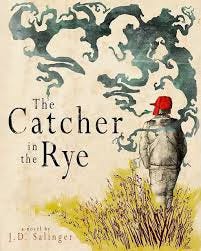
There’s this one section of The Catcher in the Rye where Holden is trying to explain to his former teacher why he blew off the Oral Expression class at the private school he’s just flunked out of. He explains:
“It’s this course where each boy in class has to get up in class and make a speech. You know. Spontaneous and all. And if the boy digresses at all, you’re supposed to yell ‘Digression!’ at him as fast as you can. It just about drove me crazy. I got an F in it.”
“Why?”
“Oh, I don’t know. That digression business got on my nerves. I don’t know. The trouble with me is, I like it when somebody digresses. It’s more interesting and all.”
“You don’t care to have somebody stick to the point when he tells you something?”
“Oh, sure! I like somebody to stick to the point and all. But I don’t like them to stick too much to the point. I don’t know. I guess I don’t like it when somebody sticks to the point all the time. The boys that got the best marks in Oral Expression were the ones that stuck to the point all the time—I admit it…
But what I mean is, lots of time you don’t know what interests you most till you start talking about something that doesn’t interest you most. I mean you can’t help it sometimes. What I think is, you’re supposed to leave somebody alone if he’s at least being interesting and he’s getting all excited about something. I like it when somebody gets excited about something. It’s nice.”
Why stray from the point? In our writing (and our lives), we were taught to stick to the point—efficiently move from one thought to the next most logical thought, the ‘plan of action’ to ‘executing the goal.’ So we stick to the story we’ve decided in advance of our writing to tell, we plan out the case we’re going to make, and we don’t allow in any thought that doesn’t seem familiar—that wasn’t already imagined. Even writers who understand writing as ‘discovering what I think and feel’ and a process of creating meaning still struggle to drop the expectation and allow their unplanned thoughts space on the page.
This can be a substantial block. Rigidity shows up so much in first drafts, with writers self-policing and ‘pre-editing’ what they’re allowed to say–they’ll hear the judge’s voice: ‘that story is probably not relevant to the point,’ or ‘that thought isn’t the right next one, you must not know anything really.’ A writer might be brave enough to sit down and try to communicate an idea or plan or story, and as soon as they hit a ‘snag’ and feel themselves ‘veering off course’ or ‘becoming unclear’ or ‘jumping ahead too soon,’ they just stop. They rear back and drop the writing altogether. Something must be wrong with me!
Really. The block can truly feel like ‘no one else understands me, I can barely capture my thoughts on paper, this is pointless.’ The comorbidity of this block is a sense that this is all a problem with the writer’s mind. It’s ‘too much,’ ‘wild,’ and ‘doesn’t make sense to anyone.’ The downstream effects of such beliefs are tragic, thinking that it’s pointless to even try to connect.
Or, a writer might continue despite these doubts to struggle through the first draft, grasping along the way for the next right thought or appropriate sentence they will allow themselves to write down. They find writing painful and wonder why they aren’t getting anywhere. They’re not able to deepen their thinking and discover what else they know or want to say, so they become repetitive.
Sometimes the writer feels they can’t even start writing because they do not know what they are going to say. ‘That’s not efficient, to start something if I don’t know where it’s going to go. How do I know it’s worth it? I don’t.’ They have a notion, observation, or feeling, but don’t write about it because they don’t know why it stuck out to them. They don’t understand the connection. So, instead of using writing to figure out why they noticed this thing, or why it happened, or what’s interesting about it, or where it takes them, they have to just… let it go.
There are no meaningless sequences
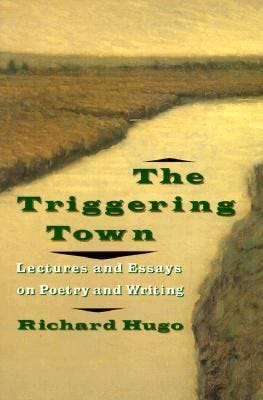
In “Writing Off the Subject” from The Triggering Town, the poet Richard Hugo wrote, “It is impossible to write meaningless sequences. In a sense the next thing always belongs. In the world of imagination, all things belong.”
Do you feel that? I find this notion heartbreakingly beautiful. Creativity is making connections.
Wandering, digressing, following resonance and impression, letting one image, memory, sentence lead to the next without ‘understanding’ the sequence first–these allow you to discover your interests, desires, questions, to encounter memories and feelings that are usually blocked away, and to respect and delight in your own mind and the fascinating, curious, sometimes inscrutable routes it travels.
The connections it makes ‘automatically’ or without you ‘trying.’1 The liquid chain of impression, resonance, association, image, idea (plus excitement, confusion, wonder), how it spools through your mind-body–let it transform your writing craft and your self-conception. I have seen this idea be the difference between writing in agony toward a meaningless expectation, and writing in joy, spontaneity, and even awe, toward who-knows.
The mind cannot help but make meaning, if not sense—I think that’s what Hugo’s saying with the idea that there are no meaningless sequences. It is impossible to be meaningless when you record a sequence of thought. Think about that. It is impossible that it does not have meaning, because a connection was made.
It is also about the discovery of what one really means or wants to say. In that essay Hugo explains how immature poets stick to their “triggering subject,” rather than allowing the process of writing to reveal the “real or generated subject, what the poem comes to say or mean.”
How do we do this? Just by thinking about it differently, you’ll feel a change, especially if you struggle a lot with the voice of the judge or editor policing what you’re allowed to write down. I also like pushing it to a further extreme just to see what the hell happens–what happens if we try not to make a point or logical sequence? Here’s the exercise Hugo gives us in Triggering Town: “Make the subject of the next sentence different from the subject of the sentence you just put down.”
Think of a detail from your hometown, or a place from your childhood.
Beginning with that detail as a first line, write for ten minutes, attempting to make each line you write different from the subject of the last line.
The point of doing this is not to intentionally “be illogical” or make no sense. It’s to see, what gets generated when I free my mind from the task of describing or proving? When I allow my mind to be associative, and I value these associations and links, what do I discover about my mind and the world I started with?
The real impact of allowing your sequences
My metaphor for the power of metaphor is how the human eye measures the brightness of a star—you cannot look directly at it to see how bright it is. You have to look slightly to one side.
The power of digression is similar. To digress means to step away from the ‘appointed course,’ to set off, to go aside, to deviate. When we set out to ‘be true to the appointed course’ (to stare directly at the star), we fail. The process can also be agonizing, as we scream DIGRESSION! at our own minds which only naturally wander. To adopt the wisdom of Titus Andromedon, the eyes are the outside mind. So maybe the mind also needs to look off to the side to see what’s really there.
This is no small deal. Many writers I work with are neurodivergent, who identify as having ADHD, or being on the autism spectrum. People whose minds move really fast, who seem to ‘jump from one thing to the next’ or are ‘not able to slow down and explain their thinking to others.’ As I mentioned above, when others don’t always understand us, we can start to think that we are broken. That our thoughts don’t move correctly, don’t make sense, and really do jump randomly around without rhyme or reason.
When you start to imagine that there are no meaningless sequences, you can relax in your writing. Can you feel that difference? You can say, ‘Ok, I don’t know how these things connect yet, but I know they do–let me get it out and see.’ You can say, ‘Ok, if I struggle to imagine that others will understand me, it’s not because my thoughts do not make sense. It’s because I haven’t yet expressed the meaning of the sequence.’
You can stop forcing yourself to turn away from what you think of as ‘distractions’ or ‘too much’ or ‘why am I remembering that story right now?’ or ‘is this worth it?’ You can just get it out, and then you’ll be able to actually see what it’s worth, and how to make the worthwhile connections visible to others. You will discover new meanings and ideas and feelings and passions and depths. Depths most of all. And pleasure most of all, in one’s own miraculous wandering mind. I promise. I’ve been seeing it happen for years.
It’s nice.
Thank you for reading! I’ll be back soon with #2 of my series on artificial writing and philosophies of alienation. I’ve also been posting a ton of notes lately of writing tips and philosophy, if you want more from me, follow along on Substack. Happy writing and solidarity to all those who write in the resistance—may we all deviate.
I wrote about steam-of-consciousness writing and ‘first thought, best thought’ in my essay Chaotic Good. I think of this as a way of putting ‘no meaningless sequences’ into practice. But stream-of-consciousness isn’t always how you’re writing, and there are many other ways to incorporate this philosophy into your writing relationship.
This resonates so much. I also think that allowing your mind to make connections and chain logic together on the page, instead of pre-policing it in the mind, helps you see that there can be multiple logics in play.
For example, in my current project, I'm writing about a couple that drifts from a toxic to an abusive dynamic. There's a scene partway through where I wasn't self-policing and let the husband hear out the wife's questions and accommodate her. Then, I had to correct myself and insert a different logic, because I wasn't capturing his descent into mistreatment. In a previous draft, this would have either felt like a failure or, even more likely, I'd have strangled my creativity by trying to force this character down a pre-conceived route. By letting him be nice and recognizing this logic as the "wrong" one for this point in the story, it actually made it much easier to invert what happened and fix it.
As you said, there are no meaningless sequences. Giving yourself the freedom and the validation to write something meaningful allows you to write, first of all, which is probably always most important, but it also allows you to see different meanings, too. I think I've only done this haphazardly, so this post is really helpful for encouraging myself to do it more in the future. Thank you!